Donation Form Below
DMRF Canada, in partnership with the Edmonton Support Group, continues to advance better care, expand treatment options, and drive research toward a cure for dystonia. We’ve made meaningful progress, but there is still much to do. DMRF Canada remains deeply committed to this work, and once again we are asking for your support. Please help us move closer to a cure by making a gift today. Click here to read our 2025 Letter.
- “Two Generations, One Hope: Be Part of the Cure for Dystonia” - Julie Trant's Story
 It was the summer of grade 7 and I remember being in my favourite place, my family cabin, running down the hill to the beach when the toes on my right foot seized and turned under. I couldn’t unclench them. I eventually pounded them flat against the ground but then other odd foot movements occurred; my right foot dragged and torqued awkwardly making it difficult to walk. I had long experienced strange movements in my hands that made writing messy and difficult. My elementary school teachers concluded that maybe I wasn’t right-handed and I trained myself to write with my left hand. The uncontrollable excessive force my hands used left holes in the page.
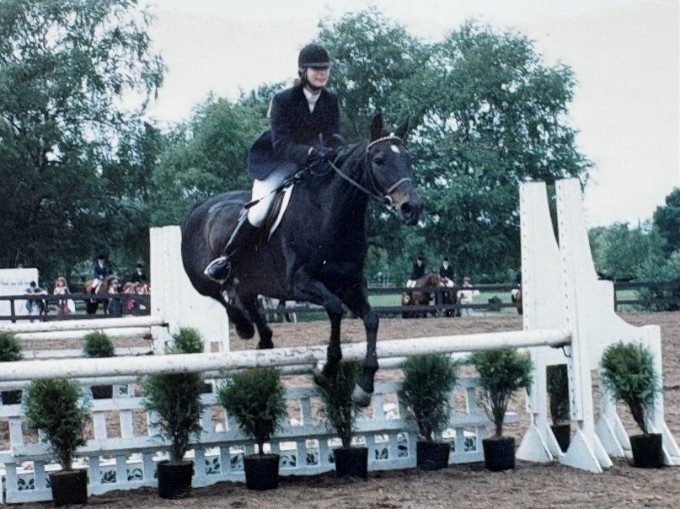
Thankfully, with the help of my aunt, who was a family physician, and my concerned parents, we were able to navigate the diagnosis. After a battery of tests, we finally ended up at a movement disorders clinic, and I was diagnosed with dystonia. My dad remembered a cousin of his who was very contorted and could not walk but could ride a bike. We now know that the paternal line of our family is a carrier of the DYT-1 gene.They gave me a bleak prognosis, informing my family that most people with child onset generalized dystonia end up disabled and in a wheelchair. At the time, my strategy was to ignore it and soldier on. I did not tell anyone about my dystonia diagnosis except my close friends and family. I was scared but I compartmentalized this fear and took solace in activities where you couldn’t tell anything was wrong. For me this was horseback riding and I felt a true kinship with the horse I leased, Magic. She really was magic for me as the warmth from her body eased my discomfort and muscle contractions, and I felt relief.
My high school experience was hampered by dystonia. I could no longer write clearly, and I didn’t want my classmates to know of my condition. I lied if asked why I was limping or walking funny saying that I had a skiing accident. I skipped a lot of school to go ride Magic but eventually decided that I wanted to go to university. My grandparents bought me a laptop computer so I could take notes and keep up with the rest of the class. I was a poor typer as I couldn’t hold my hands properly over the keys but I adapted and eventually conceded that I needed some accommodation - a bit of extra time and access to a computer.
I tried to hide my condition from most people. Over time my gait worsened to the point where my foot dragged so much that I would grind through shoes monthly. I eventually sought help at a movement disorders clinic where I got Botox to help alleviate these symptoms. Drinking became difficult too as my hand spasms worsened. I’ve received countless quizzical looks from strangers and was even asked by a stranger once if I was dying. I’m embarrassed to admit that well into adulthood my overarching feeling about having dystonia was shame.
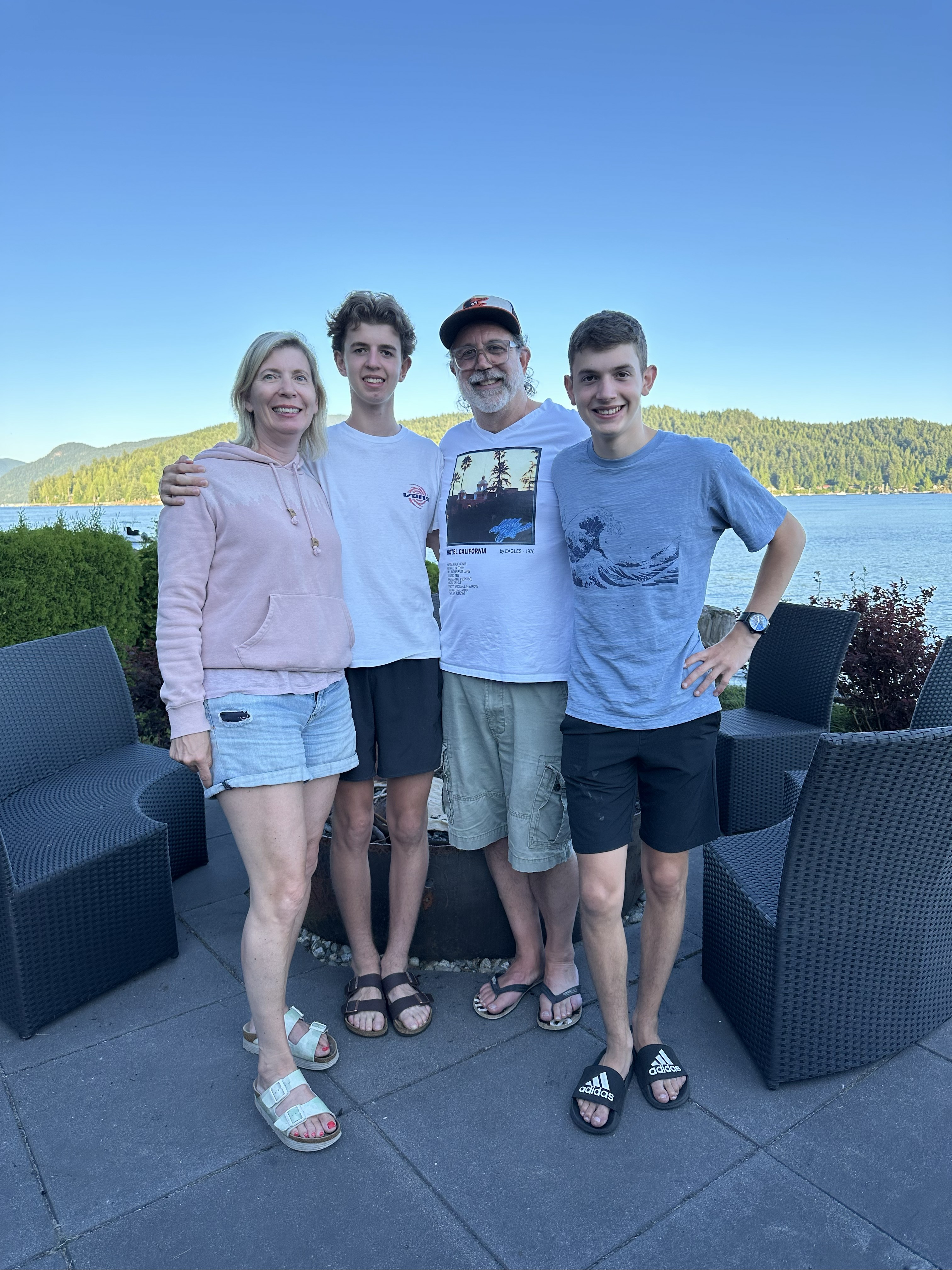
 Fast forward to me getting married to the love of my life, Lance Howitt, in 2000 and the birth of my two sons - one in 2007 and one in 2009. My kids were both healthy and there was no sign of dystonia until the Spring of 2017 when my youngest son was only 8. Overnight he began showing the telltale signs of dystonia. His foot pronated and his toes cramped. Soon it became evident that my son presented with much more aggressive symptoms of dystonia than me, as his back contorted and he rapidly became more disabled. Eventually he was only able to move a few paces before he careened off and was visibly contorted at all times.
I can’t explain the depth of the guilt and anguish I felt as my little angel was ravaged by the crippling effects of dystonia. I always assumed that if anyone else inherited the dystonia gene that the effects would be at worst like the version I got and at best never to display at all.
It was an extremely difficult time for our family. Diagnosis was swift but unfortunately, he was not responsive to dopamine. Eventually, our neurologist referred us to Deep Brain Stimulation (DBS) specialists in France. They were so kind, reassuring and knowledgeable that we made the decision, packed up our family, and flew to France in December of 2017. It was clear my son needed DBS intervention soon to avoid a dystonic storm.
Quite simply a miracle took place for us there. We were promised at least a 50% improvement in his symptoms and have gotten so much more. Our son is now able to do absolutely everything he wants with ease, and the dystonia is often undetectable. Through teamwork of my son, overseas specialists who manage the programming and local nurses who administer the setting changes, the positive outcomes of DBS continue to be life changing.
In the end, the success of my son’s neurosurgery gave me the courage to do the same. At one point I had been told that I waited too long and that DBS surgery would no longer help me. Nothing could be further from the truth. In November of 2018, I underwent DBS surgery in France and with time and careful setting adjustments, by 2020 I could walk freely for the first time. I now walk, eat and drink with ease. Even my writing has improved to the point where I can fill out a form or jot down a note. Truly incredible. My son gave me the courage to have the surgery and without his bravery I wouldn’t have the carefree movement I enjoy today.
I hope one day that we will understand the brain and be able to help all who suffer from dystonia. I’m fortunate that the genetic type of dystonia is very responsive to DBS but many other types of dystonia are not. My husband, Lance, and I are committed to financially supporting dystonia research to find a cure for everyone and ensure it is accessible.
There is so much neuroplasticity in the brain - we just need to understand why in some people the dystonia remains latent and in others is so pronounced.
I am now strong enough to admit that I have a neurological condition called dystonia and don’t feel shame. I feel hopeful that together with funding for dedicated researchers and increased awareness through DMRF Canada we will find a cure for one and all.
Thank you for joining us in our quest to make a cure for all those with dystonia, a reality.
If you would prefer to make your donation through Canada Helps, please click here