- Dystonia is a Movement Disorder
Dystonia is a neurological disorder that causes excessive, involuntary muscle contractions. These muscle contractions result in abnormal muscle movements and body postures, making it difficult for individuals to control their movements. The movements and postures may be painful. Dystonic movements are typically patterned and repetitive.
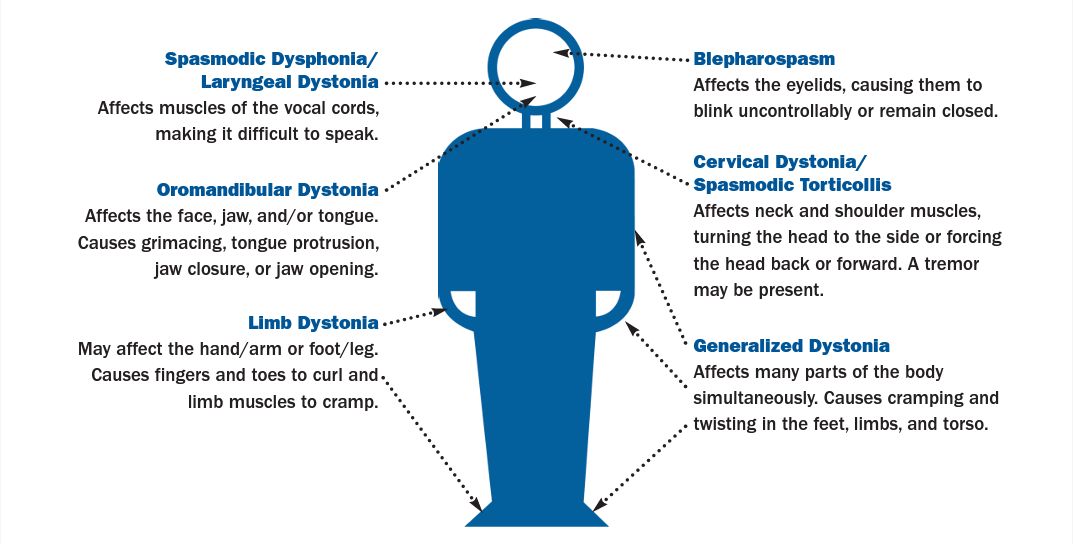
Dystonia can affect any region of the body including the eyelids, face, jaw, neck, vocal cords, torso, limbs, hands, and feet. Depending on the region of the body affected, dystonia may look quite different from person to person.
In addition to involuntary movements and postures, depression and anxiety are frequent non-motor symptoms of dystonia.
Primary dystonia affects an estimated 300,000 people in the United States and Canada. But that is just the tip of the iceberg when it comes to understanding the true prevalence of all dystonias.
Secondary dystonias that are caused by a number of diseases and traumas are much more prevalent than the primary forms. When we look at the dozens of diseases that can cause dystonia such as Parkinson's, Huntington's, and Multiple Sclerosis the numbers of dystonia can be propelled into the millions.
With this in mind, it is fair to say that discovery in dystonia research can have a far-reaching impact on diseases such as Parkinson's and Huntington's and other neurological diseases and disorders.
- Common Signs of Dystonia
- A body part is flexed or twisted into an abnormal position.
- Repetitive and patterned body movements, which may resemble tremors.
- Dystonic symptoms may worsen or occur only with specific tasks. For example, hand dystonia may be present only when writing or playing a musical instrument.
- Attempting a movement task on one side of the body may activate dystonia symptoms on the opposite side.
- Dystonic movements and postures may be temporarily relieved by a gentle touch or specific action called a sensory trick.
- How is Dystonia Diagnosed?
At this time, there is no single test to confirm the diagnosis of dystonia. Instead, the diagnosis rests in a physician's ability to observe the symptoms and obtain a thorough patient history. Medical tests may be ordered to rule out other conditions or disorders.
The sub-specialist who typically has the training to diagnose and treat dystonia is a movement disorder neurologist.
The dystonia diagnostic process may include:
- Patient history
- Family history
- Physical examination to assess the functioning of the nervous system
- Laboratory studies such as blood and urine tests, and analysis of cerebrospinal fluid
- Electrical recording techniques, such as electromyography (EMG) or electroencephalography (EEG)
- Genetic testing for inherited forms of dystonia
- Additional tests and screenings intended to rule out other conditions or disorders
- Common Misdiagnoses
Dystonia symptoms should not be confused with:
- Orthopedic conditions (for example, scoliosis and congenital torticollis)
- Muscle cramps
- Muscle contractures
- Essential tremor
- Tics
- Dystonia Vocabulary
Your healthcare providers may use unfamiliar language to talk about dystonia:
Focal: Dystonia that affects a single body part, for example, the neck.
Segmental: Dystonia that affects two or more connected body parts, for example, the face, neck, and arm.
Generalized: Dystonia that affects the torso and at least two other body areas, frequently the limbs.
Isolated or Primary: Dystonia is the only neurological symptom a person appears to have.
Acquired or Secondary: Dystonia that appears to have a specific cause such as drug reaction, brain injury, or as a symptom of another neurological or metabolic disorder.
Paroxysmal Dyskinesias: Dystonia may occur in episodes, often with additional movement symptoms.
Functional: Dystonia may occur as part of a functional neurological disorder.
- 2025 Definition and Classification of Dystonia Update
In May 2025, an updated definition and classification of dystonia was published in Movement Disorders. This update builds on the original 2013 consensus publication and incorporates important scientific advances made over the past decade, particularly in areas like genetics and cell biology.
Over time, the original classification had been interpreted in different ways, leading to inconsistencies in how it was used in clinical settings. To address this, an International Consensus Committee, consisting of investigators with years of experience in different aspects of dystonia, was formed with sponsorship from the International Parkinson Disease and Movement Disorder Society (MDS) Dystonia Study Group, the Dystonia Medical Research Foundation, the Dystonia Coalition, and Dystonia Europe.
The committee members reviewed and revised the definition, classification, and terminology of dystonia, to make them clearer and more practical for healthcare providers, while also creating a guide for future dystonia research. This updated consensus is designed to help doctors better recognize, diagnose, and treat dystonia, so patients can get more accurate care and support. It also helps ensure that people all over the world are using the same concepts and terminology when talking about and studying this condition.
Formal Definition of Dystonia
The authors decided to retain the definition of dystonia with only minor clarifications to the wording. Dystonia is defined as “a movement disorder characterized by sustained or intermittent abnormal movements, postures, or both. Dystonic movements and postures are typically patterned and repetitive and may be tremulous or jerky. They are often initiated or worsened by voluntary action and frequently associated with overflow movements.”
How Is Dystonia Now Classified?
The system still uses two main “axes” to define and classify dystonia:
Axis I: Clinical Characteristics
- Age of Onset of Symptoms – can range from infancy to late adulthood
- Family History – whether dystonia is likely genetic or appears sporadically
- Body Areas Affected – e.g., just the neck (focal), or several body regions (generalized)
- Timing and Course – how and when symptoms start, and whether they change or stay the same over time
- Movement Features – how the dystonia occurs: Does it happen with movement? Is it tremor-like or jerky? Are there ways to ease it?
- Other Symptoms – whether dystonia is the only issue or occurs alongside other movement disorders or neurological symptoms
Axis II: Causes and Biological Mechanisms
- Genetic Factors – recognizing the genetic forms, whether inherited or not
- Acquired Causes – like certain medications, toxins, or injuries
- Brain Imaging Clues – identifying areas of the brain that might be damaged
- Biological Processes – such as developmental factors, cellular or metabolic pathways, or immune reactions
What’s New and Improved in the Updated Publication?
- More precise descriptions of symptoms and their timing
- New terms that reflect novel developments in genetics and molecular biology
- A clearer guide to help doctors connect symptoms with possible causes
- Useful for both everyday medical care and future research and treatment development
Impact of the New Definition and Classification
This new system recognizes that dystonia can affect people in many very different ways and originate from a variety of genetic and non-genetic causes. It offers a more detailed and clearer way to understand and classify dystonia. Ultimately, it is designed to help neurologists make better diagnoses and researchers explore more targeted treatments.
- Age of Onset of Symptoms – can range from infancy to late adulthood
Click here for a printable 'What is Dystonia' overview
Click here to download the "What Is Dystonia" brochure
Click here for an overview of dystonia and information on treatments, courtesy of DMRF
This information has been taken from the Dystonia Medical Research Foundation (DMRF). Thank you to DMRF for allowing us to share this information.